I keep feeling compelled to write something about the beginning of this process that has ended up with me obsessing ever so slightly over old PCs, because I've been bingeing The Retro Hour podcast for a few months now and it's bringing up a lot of memories. I guess I'd like to get them down 'on paper' before they are forgotten forever.
From the earliest age (possibly around 3 or 4), I was taking stuff apart. One of my first words was "screwdriver", though I apparently said it as "koo-ra-ra". On one occasion I unscrewed a bunch of door handles and it took my parents a while to get in or out of any of the rooms. Whenever I would get a toy that was cool or that I was curious about, I would take it apart. My dad visited his brother in Singapore on one occasion and brought me back this pretty awesome radio control truck - probably the nicest thing I'd ever received as a gift. Apparently I took this apart to the point that it wouldn't work anymore. I guess my dad wasn't smart enough to put it back together, huh?

My first memory of an experience with a computer was the solitary BBC Micro my primary school had. I grew up in Hornchurch, Essex and went to a Catholic primary school. The head teacher was a nun, that's how long ago it was. Anyway, it was the mid-eighties and pretty much every school in the country had at least one BBC Micro. Based on my memory of the classroom I was in, I think it must have been 1st year juniors (equivalent of year 4 today) that I remember playing Granny's Garden on the Micro. It was a collaborative effort with other students, and I have such a vivid memory of what I believe to be the end of the game (though it may just have been the point at which the game ended for me). I haven't played it since, but my basic understanding of the game is that you have to visit various settings while searching for some children a witch has kidnapped. This particular scene was a cupboard under the stairs, I think, and we had the choice of looking behind a couple of brooms, one which was red and one which was green. I really clearly remember thinking "well, we should choose the green broom shouldn't we. Oh, but what if it's the red one even though that means danger??" I think it was the first time I was aware of encountering reverse psychology and engaging in some kind of critical thinking. I would have been about 8 or 9 I guess.
The next time I remember encountering the Micro was the year after when we got to use the plotter aka 'turtle' to draw geometric shapes on a massive bit of paper on the floor using the LOGO programming language. I seem to remember quite enjoying this but I also remember not being particularly fascinated by this machine at the time. I just kind of took it for granted that it was there. I much more enjoyed toys like Big Trak, which I remember friends having.
In terms of home computing and games, I would go round my friend José's house. He had a Commodore 64 and whenever I went round his for dinner we would go to the corner shop and pick out a game to rent for the evening. They had a whole bank of cassettes and I remember one day picking up Platoon and suggesting that it looked potentially good - he said otherwise. We would then go home, start loading the tape, have dinner while that was happening, and go back upstairs to his room to see if the loading had been successful or not. This must have been around 1987 or '88. The game I remember the most is Excaliba, by Mastertronic, which is basically Chuckie Egg, in a castle. I can still hear in my head the tune that plays at the beginning of the level.

I can't for the life of me remember any other games that we played bar one and that was the day José proudly presented to me Robocop 3 on cartridge. Instant loading times! Given that I was about 9 or 10 at the time, I hadn't seen the film, but I knew kids at school that had. It didn't seem uncommon for 10-year-olds to have seen a film rated 15 for some reason.
One thing I became more interested in around this age was electronics, which was a natural extension of taking things apart. This was never picked up by my parents, however, so I never received any real encouragement or tools that would help me advance in this. I did receive the odd electric shock from the mains, though. On one occasion I took apart a disposable camera on the coach journey back from a school trip. Amusingly this camera's built-in flash was charged and I accidentally touched the contacts of its chunky capacitor, giving me a decent shock. Having received mains shock previously, I knew it was a high voltage. One of the parents on the coach asked me if I was okay, I told him what had happened and his response was something like "hah, yeah about 3V maybe". Clearly he didn't know how capacitors worked, but this event was a crucial moment in my own electronics education as I knew that I knew exactly what had happened. Maybe I should have charged it up again and told him to touch it. I made a similar discovery when some roadworks were happening on my road. There were some traffic cones and some had a flashing light on top of them and I wanted to know how it flashed. I opened it up to find a fat battery (4R25, I think) and a capacitor across the terminals with a small lamp in parallel. I couldn't quite understand how such a simple setup could work but it explained itself really.
Around the same time I remember hanging out with Daniel across the road, who was a few years older than me. His family had an Amiga 500 on a desk in their kitchen/dining room and I remember playing some iteration of Lotus and Rainbow Islands. I also remember the day he proudly loaded up a game that had a soundtrack by Bomb the Bass, which I now realise was Xenon 2 of course. They must have had a bit of money because he also had a Mega Drive in his bedroom and I'm sure he got the Mega CD at some point as well. I can't remember many games on that system, but Streets of Rage is one of them. Again, I remember being quite impressed by these things, but not overly enthuiastic. Like I wasn't begging my parents for one of my own (but then I knew they would never be able to afford it either).
One of the other systems I really remember having any contact with around the time was the Sega Master System, which my friend Liam had. This was in secondary school so I must have been 11 or 12 at this time ('91/'92) but I can't for the life of me remember what games we played. Probably Alex Kidd. I also had the Donkey Kong Game & Watch, which my nan got for me from the airport on the way back from some holiday. I played with this for a while until my curiosity got the better of me and I wanted to know how it worked. As you may know, these games used tri-wing screws in their chassis (like the Game Boy), so dismantling was not trivial. One of the first things I did was to remove the decorative metal panels, probably to see if there was anything under them. That kind of ruined the look. Another thing I did was to make a small cut in the ribbon cable that linked the two screens to see if anything happened. I must have already known that this would fuck up the display and, sure enough, it did - certain locations of the Mario character would not display and this made the game pretty much unplayable. At some point I was able to get the case open, probably by using a soldering iron or by cutting it open somehow. I can't remember if I was fascinated or underwhelmed but the thing I remember most clearly was multiple layers of plastic with the scenery printed on them, which created that pseudo-3D look behind the LCD screens. I later took apart and ruined a Betamax toploader we inhereted from my nan.
One thing was certain during this time: I was not good at computer games. I don't have strong memories of being good at, or even particularly enjoying, playing games at all. I just didn't connect with them beyond being a curiosity.
This kind of changed in 1992 (I think). We went on holiday to Scotland that year, which is a terrible idea as it rains most of the time. I remember my mum complaining, probably while we were there, that she never wanted to spend summer in Scotland ever again because why would she spend the only 2 weeks holiday she got of the year being miserable. Fair. Anyway, around this time, Smith's crisps were running a promotion where you could win a Game Boy or some other lesser prizes. I was obsessed. Every bag of crisps had a sachet in it, which had at least a sticker included. I collected every single one in every packet we ate and I have no idea how many I ended up with, but I must have been more than 100. Anyway, I wrote a really nice letter to Smith's and put it in an envelope with all these stickers, sent it off and thought nothing more about it.
I don't know how many weeks later this was but, one day, I came home from school and there was a parcel for me. I never got post of any kind so this was very perplexing. Inside was a fucking Game Boy. I couldn't believe it. It came with Tetris and the really nice in-ear headphones.

Tetris was the first game I got really good at. I played that game for so long that, even today, I'm still pretty good at it. Other games I purchased for this system were Super Mario Land (which I still play occasionally for fun), Dr Franken (which is hard and confusing as all hell, but I loved the rendition of Betthoven's Moonlight Sonata as the music), Loony Toon Adventures or something, and I still remember the excitement of buying Super Mario Land 2: Six Golden Coins when that came out. The sprites were so much more detailed and you could do bi-directional movement in levels - none of this only moving right shit! I always took it with me on holiday and had to pause whenever we drove through a tunnel and the lighting was crappy. Obviously it was impossible to play at night.
I loved my Game Boy so much that for my GCSE Craft Design and Technology final project I made a case for it out of balsa wood and moulded plastic. It held 4 games, the Game Boy, and the link cable. Which reminds me - my friend José also had a Game Boy and I would go round his for 2 player Tetris. This would have been my first proper 2 player gaming experience. The Game Boy's eventual fate was that I upgraded to a colour model when they came out. I tried to take apart the original model, but didn't know that a tri-wing screwdriver was probably easy to obtain if I bothered looking. Instead I hacked at the screw holes with a screwdriver until I could separate the shell. Though the case was ruined I kept the innards and, years later, I bought a non-working Game Boy from eBay and transplanted the electronics. It lives on today!

My first experience with a PC would have been in the early '90s, possibly '91. My dad was a teacher and would bring home an RM Nimbus during the holidays. I remember using MS Paint in Windows 3 and loving it (Particularly the airbrush tool), but I didn't know that games could be obtained for it at that point. Computers were so confusing to me at this time that, when the Paint icon disappeared one day I kind of freaked out and my mum was able to fix it. I'm pretty sure all she did was scroll in the program group because I'd dragged it by accident. The only PC I was aware of was in the library at school - even at that time it was clear how old it was, despite having a caddy-based CD-ROM drive and Windows 2.0.
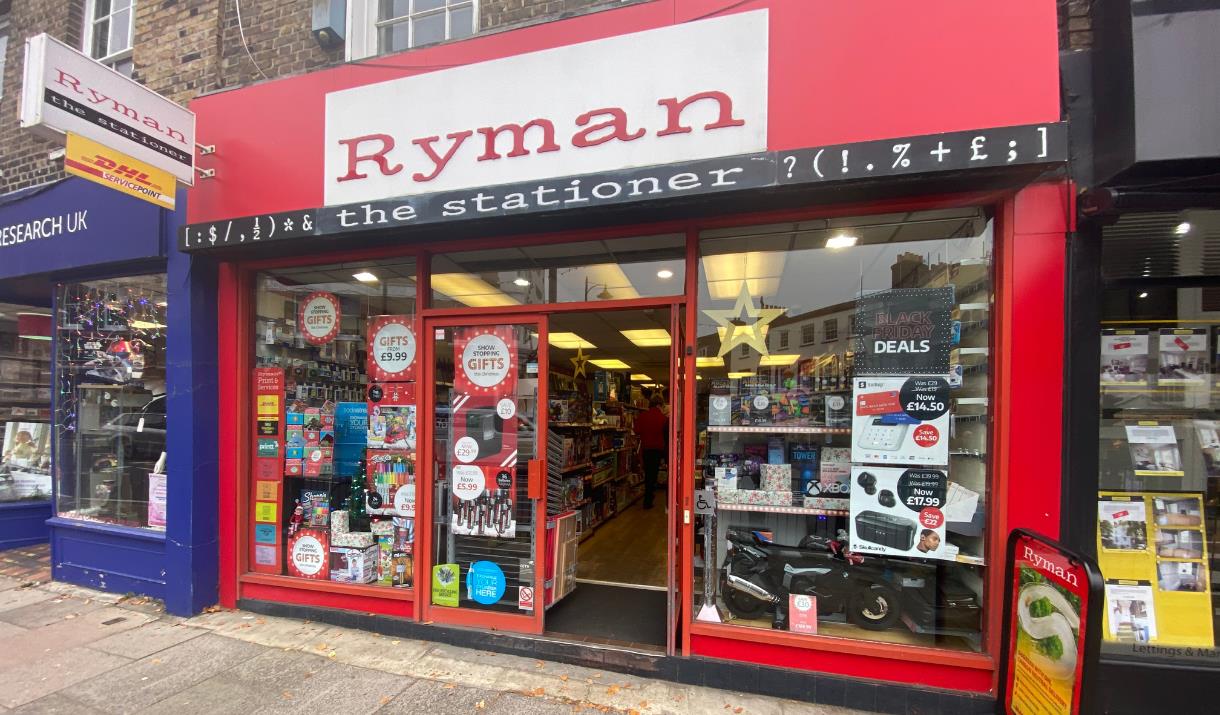
I can't pinpoint the year it happend but, around 1993, my dad took me out one day and told me we were going to buy a computer. We drove to Wilding's (later Ryman, or Ryman's because people add an S to the names of things in Essex) in Hornchurch, which was an office supplies store - dedicated PC stores didn't yet exist. Along one side of the shop they had a selection of Ambra PCs. Ambra were a subsidiary of IBM and their line of PCs were intended to compete with their own PS/1 line, oddly. I wasn't really involved in the conversations about what we would choose, but I remember the salesperson talking about the various specs on offer. We ended up getting the cheapest model, which was a 25MHz 386SX with 2MB RAM and a 40MB hard drive. We also got a printer (a compact Epson model) and had to buy a bunch of floppy disks to backup the hard drive. I remember it cost about a grand for the PC and £200 for the printer. It came bundled with Lemmings, which I probably played a fair bit. No soundcard, no CD-ROM, nothing like that.
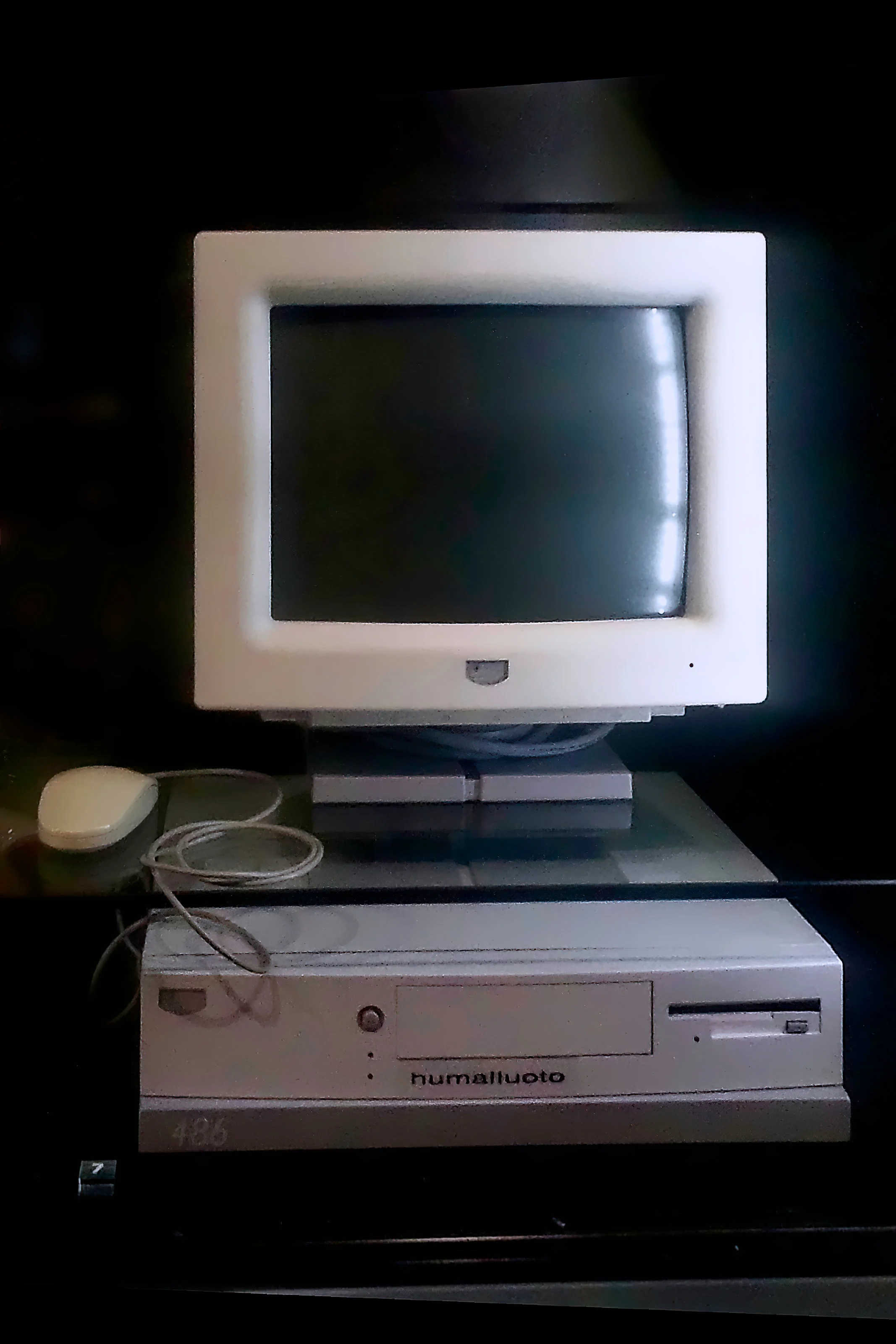
I immediately started delving quite deep into the documentation that came with it. There was a general 'computer' tutorial on the machine, plus the MS-DOS 5.0 manual and probably a Windows 3.1 one too. I remember quite early on clicking on every icon to find out what each program did and then running every executable in the Windows folder to see what they were, discovering strange programs like Dr Watson. I remember running MSD.EXE in particular, which displays a big red (I thought it was flashing) message saying "YOU ARE RUINING WINDOWS!!!", at which point I shit myself and turned the computer off. I had visions in my head of files gradually being deleted from the hard drive or corrupted by whatever I had done and it was probably my first panic attack. To my relief it still worked when I turned it on. I didn't run MSD in Windows again until many, many years later and it was then that I realised the message simply said "you are running Windows" and this was only bad because it would affect what MSD reported. Silly me.
The next thing I did was mess with the display settings. Windows was set to use 640x480 resolution and I noticed that higher resolutions could be selected in the setup program. So I set it to 800x600 or something and, when Windows restarted, the display was completely scrambled (because it was a 640x480 monitor). I went cap-in-hand to my dad, who phoned the tech support line. I'm pretty sure the idiots got us to restore the hard drive from the backup we had (thankfully) done, but it's possible they just got us to run setup from the command line and choose the correct display driver that way.

Anyway, after that point I started buying PC magazines like PC Plus, which was cool because it sometimes included games on the cover disk. One of these in particular was Paranoid, a basic Arkanoid clone. Me and my brother played that a lot and I still enjoy it today because of the nostalgia value.
Around the same time I remember going round my friend Paul's house and his dad had a portable Tandy PC, possibly a 1400 LT, though I don't recall exactly. All I remember really was the LCD screen and dual floppies underneath it. He had a bunch of games on it that he did copies of for me, including Rockford, Grand Prix Circuit, Test Drive II: The Duel, Speedball 2 and F29 Retaliator. He also had some porn disks! These consisted of extremely low-res animated GIFs which, at the time, was obviously pretty cool. I'm pretty sure one of those had a virus on it, so that was a fun early discovery. Then there was another friend, Joe, who also had an Ambra, except he had the 486 Hurdla model, which had a higher-res monitor and more RAM and hard drive. This made me insanely jealous. Remember that this was 1993 and the 386SX had been around for about 4 years at this point. Mostly I didn't notice because most games weren't very demanding. When PC Zone magazine first came out in April 1993, I bought it on a monthly basis and this was the main way I discovered and played games. That 40MB hard drive filled up pretty quickly. I also remember getting into hex editing and stuff at some point so I could do cheats and stuff.
I remember being out with friends in Romford one day, which has had a very busy marketplace since the 13th century. There was a stall which had some old big box PC games on it and, over the next few weeks I bought nearly all the ones that interested me because they were cheap. This would have included Geoff Crammond's Formula 1 Grand Prix, F117A Stealth Fighter, possibly Sensible Soccer (though I may have bought that in a shop) and others I can't remember now. I've kept most of the disks, though hardly any still work. These games were perfect for the spec of machine I had, though I couldn't run F1GP with texture mapping. I think it was on a magazine floppy disk that I found a utility that allowed you to change the colours of the cars and driver names in that game so I took great pleasure in changing them all to the current season. I wasn't at all into F1 before that, but I soon became obsessed. Sadly, the first GP I watched in its entirety was Imola 1994. How's that for bad luck. I rememeber phoning up my friend Paul after Senna crashed and my mum saying "he's dead, Andrew". I couldn't believe it, but she had seen countless drivers die over the years - it was a pretty normal thing.
I digress. I played F1GP a loads and specifically remember engaging the automatic brakes driver aid just before a corner to slow down in time and optimise my lap time. My brother was also well into this and we used to dream about being the first brothers in F1. Obviously the Schumachers got there first instead. Bastards. I got Wolfenstein 3D from a friend (the shareware episode) and my dad banned me from playing it when he found out about it, for which I was mocked at school. I don't think he was able to implement this ban, however. Most games I would discover on magazine floppies and never buy the actual game. I have written an article about all of these games, and I went out and purchased a very small proportion of them, usually from the local Game store.
One very important game for me was Pinball Fantasies. That was the first time I heard digitised music coming through the PC speaker, which was a mad thing compared to the usual bleeps and bloops.
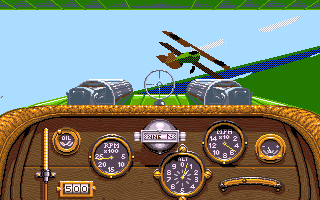
Some months after we bought the PC, we went back to Ryman's (the Romford branch, this time) and purchased a kind of gaming upgrade kit. This included an Adlib clone with built-in joystick port, a rudimentary joystick, some really basic speakers and a game pack. I can't remember exactly what games were included but this was very old stock at this point - most of my friends had Sound Blasters. One of the games was some Tennis thing (I've not been able to identify it despite scanning screenshots of the time on Mobygames) and another was Knights of the Sky. I played that a lot, and got up to 'top ace' ranking.
One of the first peripherals I bought was a CH Flightstick, probably after reading a review of it in PC Zone. I used that for everything, even F1GP. It eventually died through overuse actually. I also bought a Gravis Gamepad because that was necessary for platformers such as Commander Keen and Duke Nukem. One game I did buy on the strength of a review was X-Wing. Prior to that, I wasn't really into Star Wars or any kind of sci-fi. I remember one Christmas I received a Star Wars VHS and was generally disinterested (especially as it was The Empuire Strikes Back! Who buys someone the last in a trilogy as their first film?) but playing X-Wing made me a complete convert. I still love that game and its sequels and it's one of the games I guess I'm pretty good at. It was so atmospheric and immersive, the music being particuarly impressive. I wasn't that good at it at the time though, as I used a trainer program from a PC Zone coverdisk that made me invulnerable.
In 1993 everything changed when Doom was released. We must have got a RAM upgrade at some point because Doom required 4MB on release, and the Ambra only had 2MB originally. I can't for the life of me remember when this happened though, and RAM was really pricey at the time (1MB was £34 according to an ad from January 1994). Doom was one of the few games I went out and bought but I also played the entire game with cheat codes, so I never really experienced it as it was meant to be. Only the last few years have I played through the entire game for the first time and my God it's terrifying at times, all because losing health was a thing.

I really struggle to remember what year this happened, but we got a full multimedia upgrade at one point. I managed to talk my dad into getting a Sound Blaster AWE32 and a CD-ROM drive. We still had a 40MB hard drive at this point, and the argument for CD-ROM was that the game data resided on the CD and freed up the hard drive. That was my understanding anyway, though it wasn't quite that simple in practice. Replaying every single game I'd ever played in glorious general MIDI was an absolute delight. Part of me thinks that the RAM upgrade happened at this time, but I'm sure I remember playing Doom with only Adlib music. I researched prices for weeks and found that the best deals could be had at Simply Computers, based in East London somewhere. So we headed down the A12 one day and purchased the parts. This was such an exciting time. That AWE32 box was so big, colourful and shiny. It was one of the earlier, really long models with SIMM sockets on it for extra wavetable samples. The thought of plugging it in and hearing that EMU chip was the best feeling in the world. Unboxing it when we got home was a great experience - so much software and even a microphone! Using Audiostation for the first time was amazing - I just wanted to play ALL the files. Using speech recognition was an obvious indulgence to get out of the way but mostly I just wanted to play all of the games I loved but with the superior wavetable soundtrack. Doom obviouly sounded amazing, as did X-Wing and many others I can't think of right now. I think there must have been a trial version of Cakewalk in there as well. Despite being very keen to make music using my computer, I did not get on with this as an interface. Even though I was classically-trained, I couldn't read a stave and the whole thing felt stilted and unnatural to me.
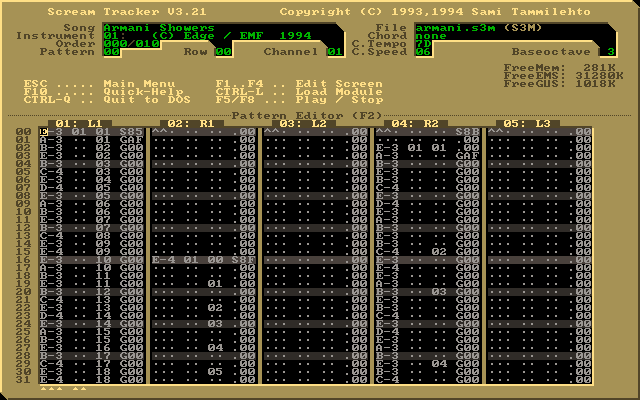
Not long after that I discovered tracking software. This first happened round a friend of my dad's. They had gone round there for dinner and I was allowed to use their 486 PC while they were eating or whatever. I found a cover CD for PC Format (a magazine I didn't buy, generally) and it had a copy of Scream Tracker 3 on it. Pretty sure I nicked that CD and installed it on my PC. I started discovering MODs, particularly on a CD that came with the November 1994 issue of PC Zone, which was the 'Gravis UltraSound Experience'. This included a whole load of demos and MODs from bulletin boards and I discovered all the classic songs that people still recognise, plus demos like Unreal by the Future Crew.
Obviously I was also able to rip all the samples from tracks I found and started composing my own songs. The AWE32 upgrade must have happened some time during '94 then. I still have some of the songs I wrote, though I lost a bunch in a hard drive crash around 2001. Either way, I used my PC to compose the coursework for my GCSE music and I think I got something like 90% for it. Annoyingly, a friend called Michael who had heard my creations, said he wanted to compose his coursework on my PC as well. I must have ended up doing about 60-70% of the work in putting his song together but he went and got 95% for his composition. I also heard a rumour that people suspected he had helped me compose mine rather than the other way round because he was a fairly talented musician. So that was annoying. Addtionally, some students felt I had cheated by using a computer, as if it had written the music for me. It probably didn't help that I had 'remixed' a song by Dr. Awesome and claimed it was my work but was forced to admit it wasn't (I mean it was partially). Hilariously my GCSE coursework song included samples from Doom.
Another thing that happened but I can't remember when exactly, was that my friend JJ (or rather his dad) had a Gravis UltraSound and he agreed to swap this for my AWE32. I had been struggling with the lack of power on my 386, and couldn't write tracks that had more than 4 channels without serious slowdown on playback. I'd read articles about the GUS, messed about with the aforementioned Gravis UltraSound Experience, and was generally craving one, so this was an easy decision. I was suddenly using 8 channels without my PC breaking a sweat and it had the full 1MB on board. This was probably the only downside because Sound Blasters could use the system RAM.
When I was 14 (this would have been in year 4 of secondary school at that time, or year 10 today) we did work experience through something called the Trident scheme. We studied a list of potential placements and chose where we would like to spend 2 weeks. I had always had a deep interest in cars and, living near Dagenham, there were a number of opportunities to go to one of Ford's sites. I think these were probably quite popular though and so were snapped up quite quickly. As a result, students who didn't get one of their 3 chosen placements were allocated whatever was left over. So I turned up at a local double-glazing firm, BAC windows, with a couple of fellow students from my year group. Having looked at my rudimentary CV (we all had to write one as part of the process), they noticed I was into computers and stuck me in the IT department. This consisted of IT support and the in-house software development team. I don't know why a double-glazing company had a team of software developers but there we go. I was put on the support team, which consisted of Neil the 21-year-old IT manager, and Dean the probationary assistant. Most of what I did at the time involved simplistic (but interesting) tasks like inventory, archiving, troubleshooting, and making cables. Neil asked me to make a parallel cable of whatever length and showed me where all the bits were. I got the first iteration wrong, but got it right the second time. Apparently this precipitated in Dean being let go because he'd tried 20 or so times and still not got one right. It's a shame I was only 14 at the time because Neil said he would definitely hire me.

The best part of this job, however, was that the department would have Doom deathmatches on their lunch break. Most of the machines in the department were 66MHz Dell 486 machines - I remember them very vividly. I also remember that they ran a Novell network. This was in the days when most people played Doom with just the keyboard, like we had with Wolfenstein 3D, though I do remember seeing people using the mouse and not being able to get my head around it. This was my first experience of networked Doom.
It was around this time that the age of my computer became painfully apparent, though again I can't remember exactly when this was. It was definitely around the time of Windows 95, but I think it must have been before that came out, so probably the first half of 1995. It was obvious that Doom was struggling a bit - I played in low detail with borders - and, increasingly, games were becoming more demanding with the advent of the Pentium in 1993. Things like Syndicate, Megarace, Wacky Wheels, Blackthorne and such. I think I must have mentioned to my dad that we needed to upgrade and he seemed amenable. So I started researching, scouring every magazine for the best prices. A Pentium was obviously going to be out of the question, but the DX4 was a very good value option. Fairly quickly I drew up a list of parts and I'm fairly certain they were from two different places to get the most value for money. I'm 90% sure the case (and possibly RAM and graphics card) came from Simply Computers again, but the motherboard and CPU (which I still have) came from some random retailer out in the middle of Essex somewhere. All I remember was that it was down the A127 towards Southend but not quite there. When we went in to get the parts, they said they didn't have the Intel DX4 in stock so we could have an AMD one instead. I knew that the Intel part had a superior floating point unit so I wasn't too happy about it, but we didn't have much choice and just went with it. Little did I know at the time that the AMD was a better overclocker. So the final list of parts was:
- Mini tower case with turbo switch and MHz display
- ABit AB-PB4 rev 1.3
- AMD 486DX4/100MHz
- 8MB 72-pin SIMM RAM
- Diamond Stealth 64 Video
- A new hard drive (possibly 1.2GB)
Obviously I chucked the AWE32 and CD drive in there as well during the build process, which must have taken two hours or so. Aside from some possible master/slave fuckery, I seem to remember the process going very smoothly and before long I had a fancy new computer. Obviously I would have spent weeks installing all my favourite games (on the old hard drive I would have had to uninstall and install stuff all the time because of limited capacity) and playing them at the new speed. I'm not sure how long afterwards I learned about overclocking, but I don't think it was long. I set the bus speed jumpers to 40MHz and ran my 100MHz CPU at 120MHz without any problems at all - 20% extra speed for no extra money!
Home computers had started to become more commonplace, particularly when the Pentium 75 came out in late 1994. Increasing numbers of friends started getting PCs. One had got theirs from Escom, which was one of the bigger high-street presences that had emerged - dedicated PC shops didn't even exist when I got my PC. Anyway, their computer was crashing quite often so they asked me to take a look at it. I worked out it was overheating and, when I checked the heatsink, I found that the Intel DX4 CPU had been sold to them as being 120MHz but was a 100MHz model! I remember my mate's dad taking us back to the shop with it where the manager very quickly switched the CPU there and then. It was a proud moment.
This is as much as I've got written down at the moment. I'll come back to it again at some point.